By Christian Wiklund
Co-founder & CEO at unitQ

AI isn’t replacing researchers first, it’s automating the executional work that teaches people how to become one. That’s the finding that came back when we put the question to more than 160 research and insights professionals, and it matters more than the usual ‘AI replaces researchers’ headline.
Here’s what they told us, and why it should change how you think about running research.
unitQ is the leading quality intelligence platform with an AI research product, so we have a stake in this question from both sides. We could have run something safe and flattering. Instead, we asked more than 160 research professionals whether AI is taking their work, using unitQ Research, the kind of tool the question is about.
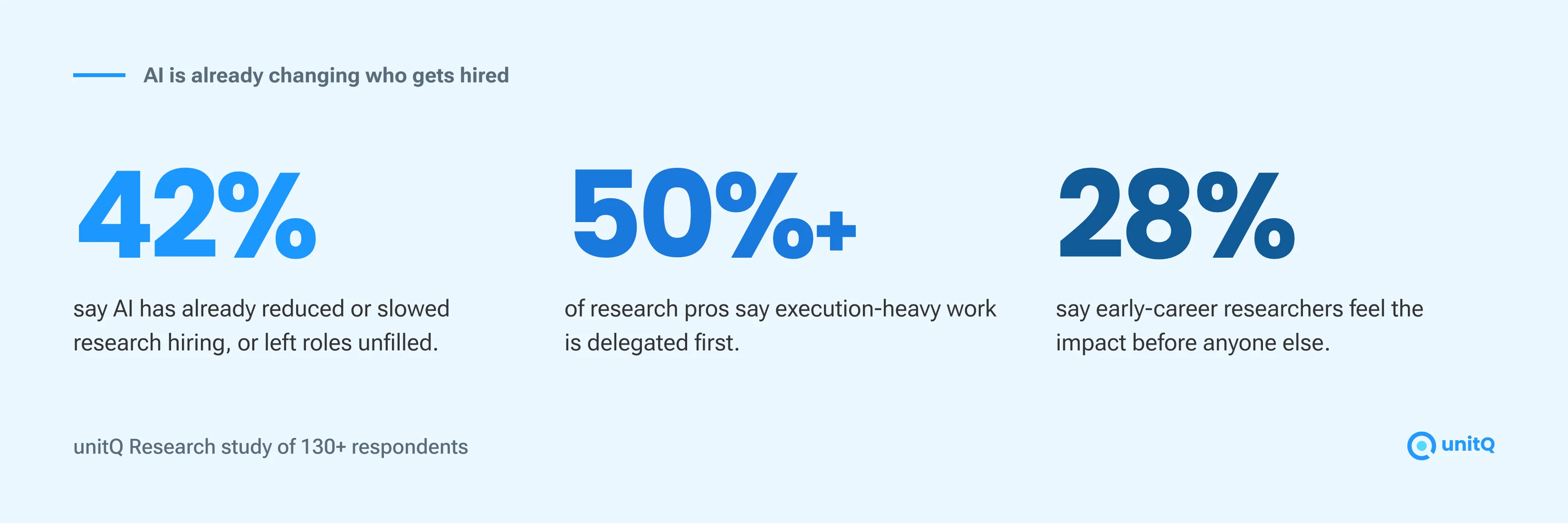
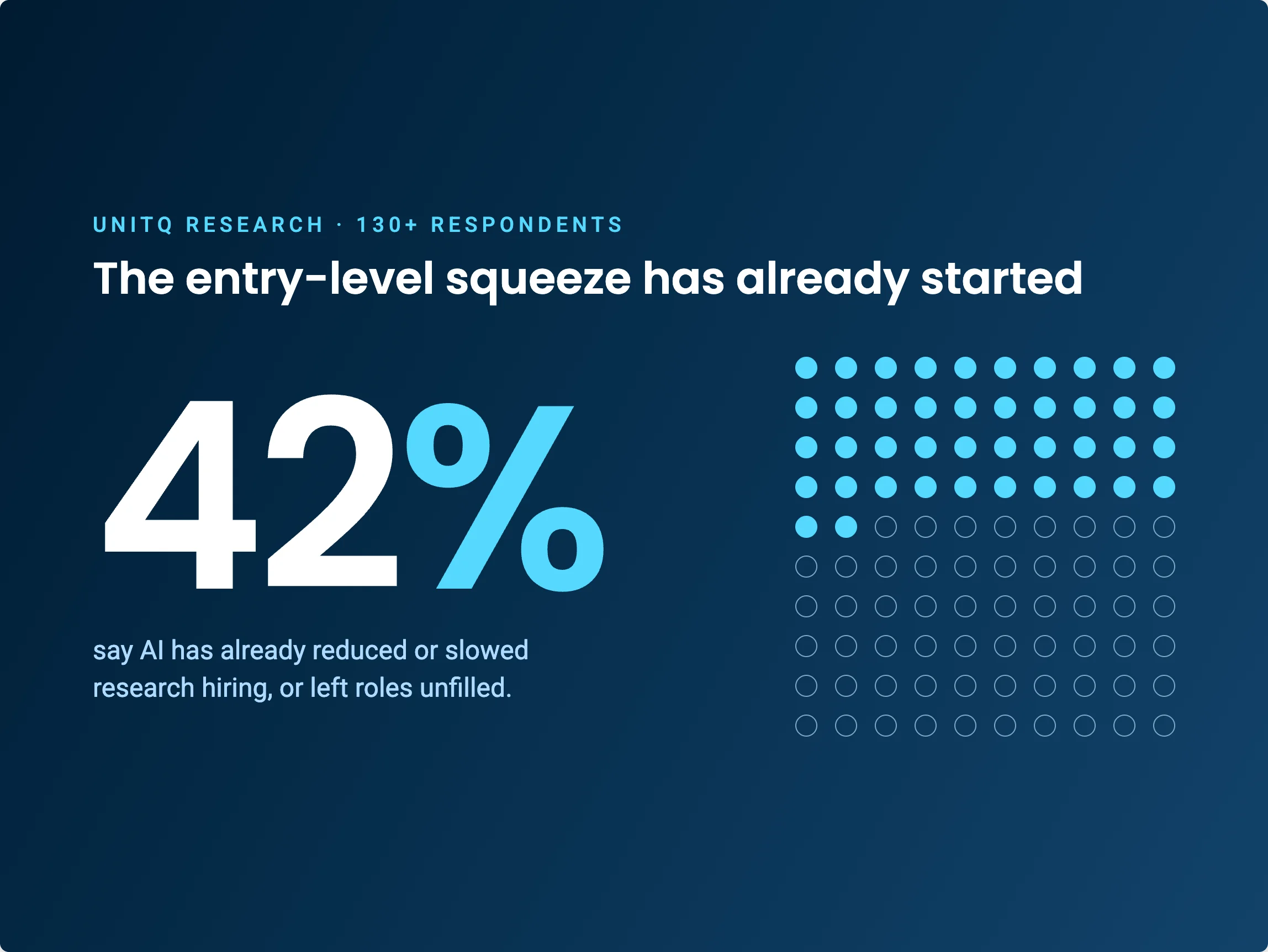
Forty-two percent of respondents said AI has reduced or slowed research hiring, or led to roles going unfilled. This is already happening on their teams, right now, and not a forecast about the next few years.
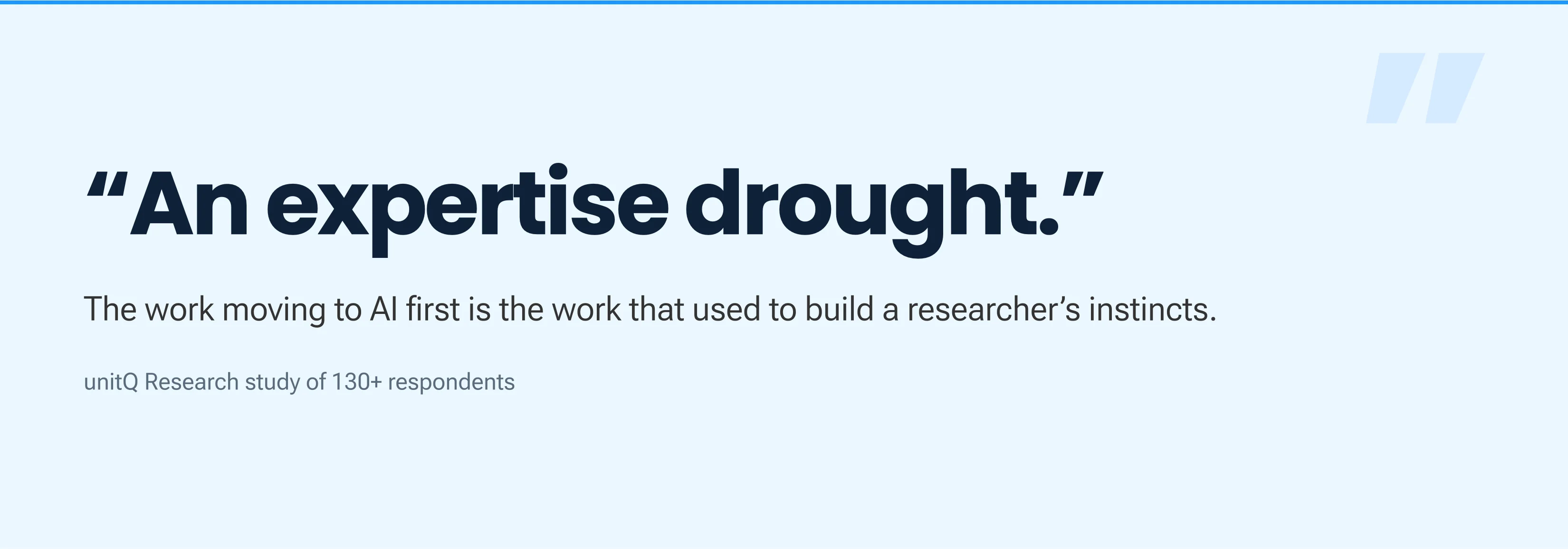
The impact isn’t spread evenly. Among research and insights professionals, 28% said early-career researchers will feel it first, and more than half pointed to execution-heavy work as the thing being handed off before anything else. One respondent called it an “expertise drought,” and the phrase stuck with us, because it names the real risk. The work moving to AI first is the work that used to build a researcher’s instincts.
Executional work is the mechanical layer of a study: recruiting and screening participants, moderating each interview the same way every time, transcribing recordings, coding open-ended responses into themes, pulling representative quotes.
It’s skilled work, and it’s also the work an early-career researcher often spends their first years doing. And that’s exactly what makes it risky to cut wholesale: owning the mechanics is how you learn to read a study. You run enough interviews yourself and you start to feel when a sample is thin, when a theme is real or an artifact of how you asked, or when a quote is representative. Strip all of that away too early and you can end up with researchers who can direct a study but never developed the judgment to know when it’s off.
If you run research, you already feel the pull of this. There’s a question your customers could answer sitting on your list right now, and the reason it’s still sitting there is that asking it properly costs weeks you don’t have. That’s the whole problem we built for.
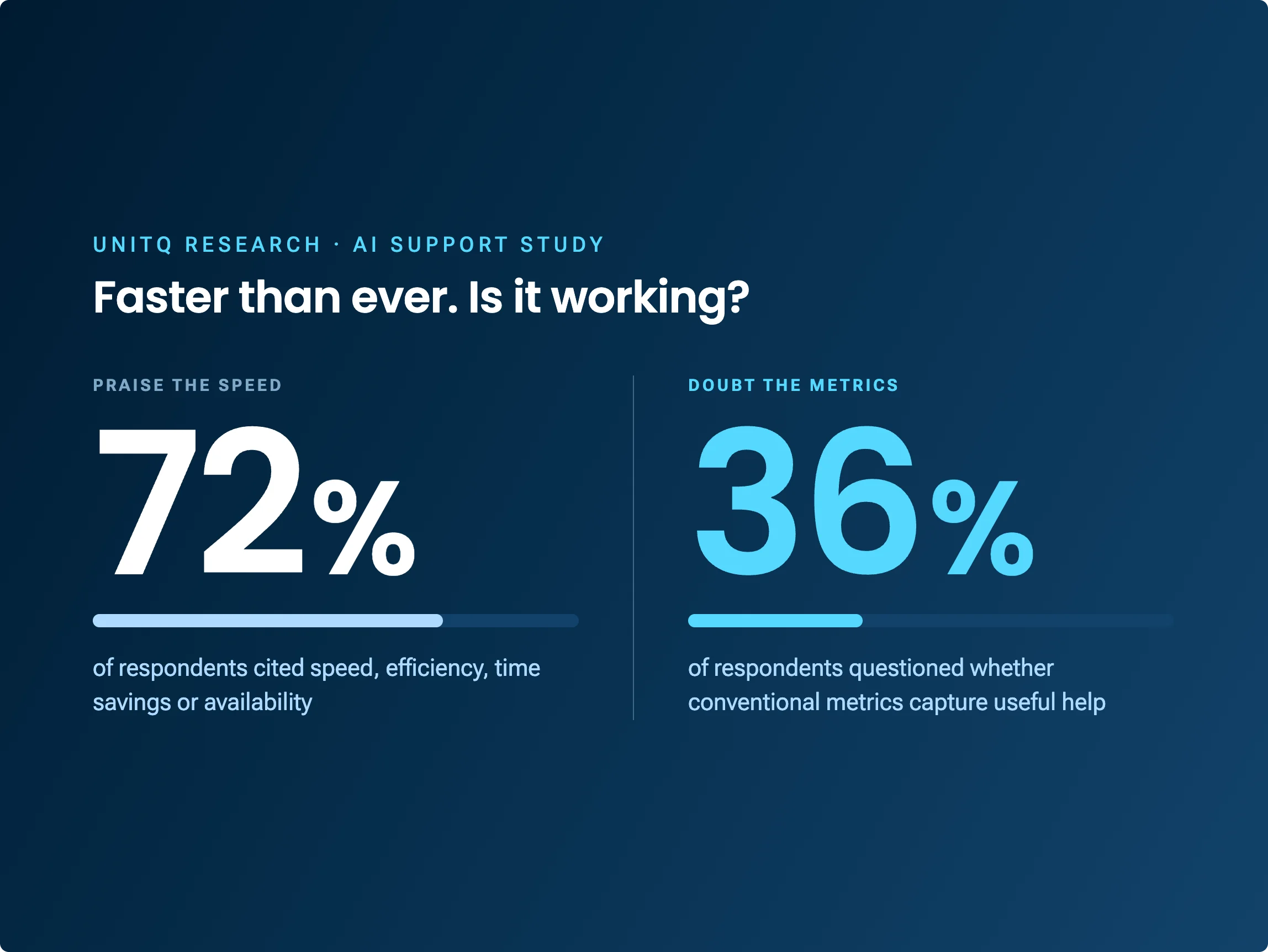
More than half of research and insights professionals said AI has made synthesis faster. But 40% warned about deskilling, or about shallow, look-alike findings that fall apart the moment someone asks how the sample was built. Four in five named at least one downside.
Faster synthesis just gets you to the decision sooner, and if the underlying insight is shallow, all that speed does is put a bad answer into motion before anyone catches it. The real danger is automating the executional work without giving anyone a good instrument to hand it to.
Strip the coding and transcription off an early-career researcher’s plate with nothing solid underneath, and the work doesn’t vanish. It moves to someone already stretched thin, gets done in a hurry, and the shallow-insight problem gets worse the further it travels.
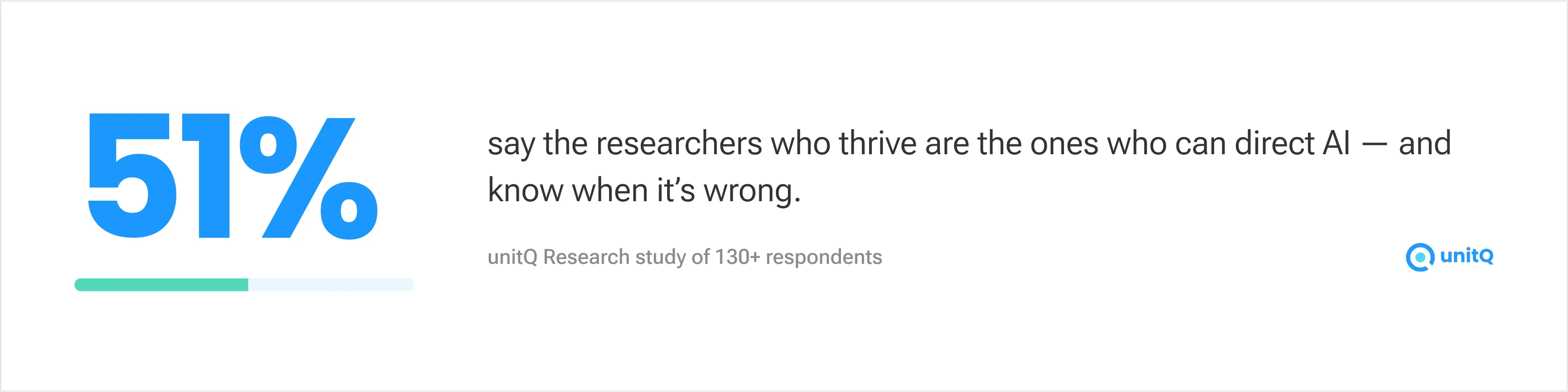
The same respondents who named the risk also named the resolution. Among research and insights professionals, 51% said the people who thrive alongside AI are the ones fluent enough to direct it and to recognize when it’s wrong.
That’s a description of the job researchers were always best at. The way to protect it is to make the tooling good enough that execution genuinely stops being the bottleneck, so more teams get to ask real questions and researchers get to spend their time on the part only a person can do.
That’s the product we built. unitQ Research gives any team the depth of a qualitative interview at the speed and reach of a survey.
Research has always forced a choice between the two ways of asking:
Human-led interviews tell you why, and they cost too much and move too slowly to reach more than dozens of people.
Surveys reach everyone and only capture what you already knew to ask, which is also how you end up sending your users their fourth grid of radio buttons this quarter.
unitQ Research is a different instrument: a real conversation that thousands of people can have at once.
It runs adaptive AI interviews and surveys by text, voice, or video, in 30+ languages the participant chooses. The interview follows up on what each person actually said, with the same rigor for everyone and none of the variability of a tired human moderator on their eighth call of the day, and respondents always know they're talking to AI. Because the conversation adapts, one study surfaces the reasons, the emotion, and the edge cases that a stack of flat surveys would’ve missed, so you learn more from each person you ask and have to ask less often.
Underneath the conversation is a real research instrument, so you can screen people out, cap a segment, branch on an answer, and carry NPS and CSAT inside the same conversation. That matters because findings have to survive the person on your team most likely to ask how the sample was built, so you always have a defensible answer.
When a study closes, themes, sentiment, quotes, and root causes are synthesized on the spot, so nothing is lost to transcription or a fading memory. What arrives is evidence, and the researcher still frames the question, challenges the output, and owns the conclusion.
Here’s what that looks like in practice:
First, you tell agentQ, the AI research agent that runs the study for you, what you want to learn and how long the study should run.
Then, it drafts the study, and you elaborate on anything you want to change.
That afternoon, you send one link, and answers start coming back.
When asking gets this cheap, the constraint stops being your calendar and starts being your judgment. The question changes from “what can we afford to research?” to “what's actually worth asking?”
The platform behind it isn't new. PayPal, Adobe, Pinterest, and Intuit already trust unitQ with their customer signal. unitQ Research puts that same depth in reach of any team with a question and a decision that won’t wait.
Want to see how it works before you dive in? Book a quick walkthrough and we'll show you how to run your first study.
We ran our study. The more useful question is the one your own customers, users, or market can answer, and it’s still open.
unitQ Research is available to start on your own today. Begin a free 30-day trial, long enough to run a study on the question that’s been sitting on your list.
Run your own research study free →
Join product and CX leaders getting the latest on customer intelligence, once a month.