By Christian Wiklund
Co-founder & CEO at unitQ

The researchers who've figured out how to use AI well didn't get their time back. Many of them are busier than before. That's not a hunch — it's what the data shows, and the gap between what AI promised research teams and what it actually did to their week is worth sitting with.
The productivity story most teams were sold hasn't landed the way anyone expected. In a 2024 study from Upwork, 96% of C-suite leaders said they expected AI to boost productivity, while 77% of employees using AI reported the opposite: it had added to their workload. The time went somewhere specific — 39% spent more of it reviewing AI-generated content, 23% learning the tools, and 21% simply doing more work because of AI.
Research teams feel this sharply, because their work is exactly the kind AI is fastest at starting and slowest at finishing. In the 2025 State of User Research report, AI adoption among researchers had soared, but sentiment stayed mixed — 41% viewed it negatively against 32% positively, and 91% worried about output accuracy and hallucinations. AI can produce a first-pass set of themes in seconds. Someone still has to check whether those themes are real.
Here's the shape of what's actually happening. AI absorbed the mechanical middle of research — transcription, tagging, a first draft of the synthesis. That should have freed researchers up. Instead, three things filled the space:
A first-pass summary you didn't write is a summary you have to fact-check against the transcripts, especially when 91% of researchers don't trust the output on its own.
When a study that took weeks now takes days, the answer is rarely "do the same amount, faster." It's "run more studies," which is how a time saving quietly becomes a volume increase.
Research roles were among those cut across the tech layoffs that totaled roughly 152,922 employees in 2024 and 122,549 in 2025, even as the number of studies climbed. At the same time, research has been spreading to product managers and customer success teams running their own AI-moderated studies — good for coverage, but it means more people producing research that someone still has to make sense of.
Put those together and the picture isn't "AI replaced the researcher." It's "the research got bigger and the headcount didn't move." The people using AI best are the ones absorbing the most of that expansion — which is why the calendars of the most AI-fluent researchers are the fullest, not the freest.
We have a hypothesis, but we'd rather have data.
We're running a live study — Is AI replacing researchers? — interviewing UX researchers, customer insights teams, and research leaders about what AI absorbed, what changed on their teams, and who they think is most exposed if roles start disappearing. Participants get early access to the full benchmark report before it's published.
If you run research, or your job quietly became running research, we want to hear from you.
The other half of our answer is practical.
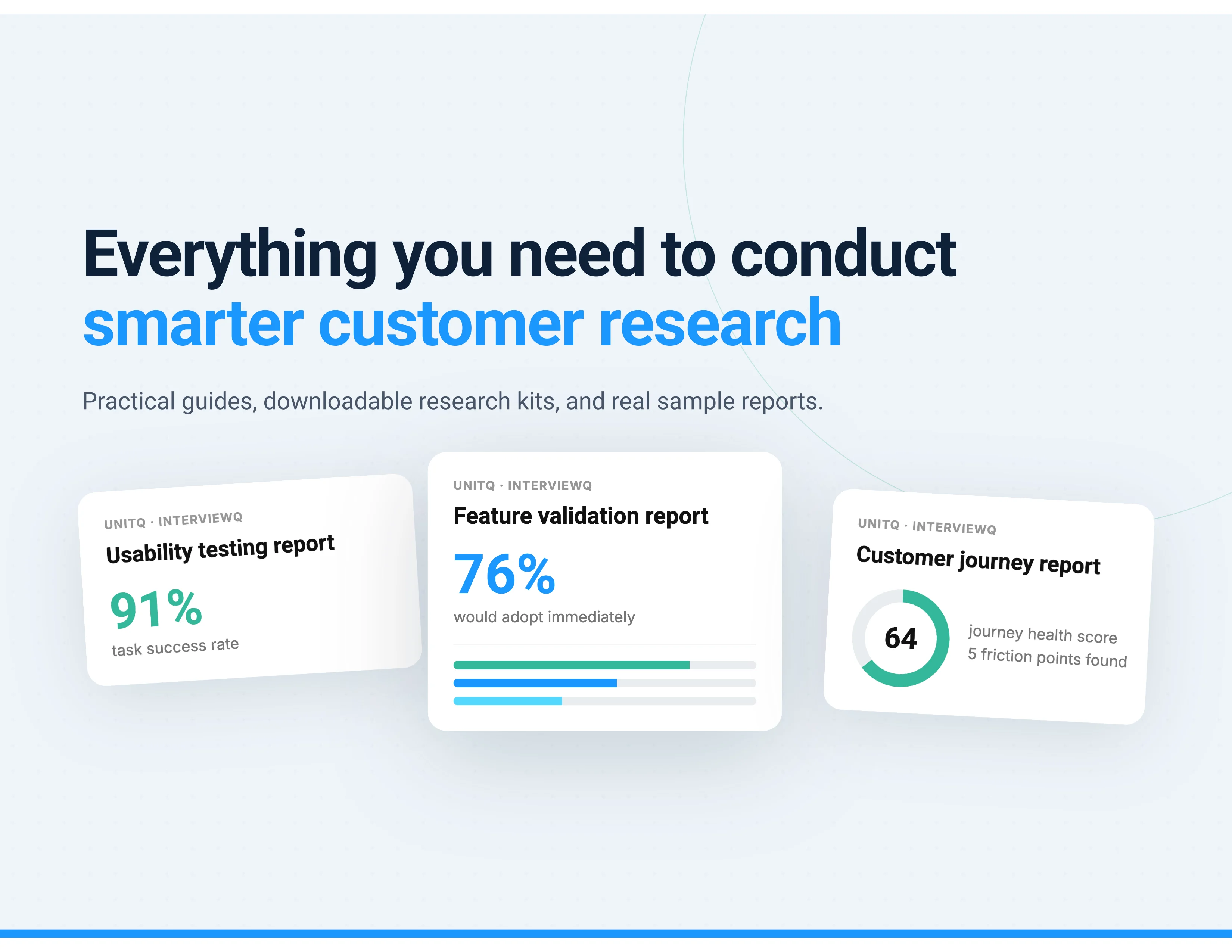
If research has to move faster with fewer people, teams need a shortcut to a good method — not another framework to learn from scratch. So we built the Quality Research Hub: a free, growing library of everything a lean research function needs to run smarter studies.
Inside, organized around the decision you're trying to make rather than the method:
Complete, repeatable systems for feature validation, usability testing, customer journey mapping, and concept testing, each with interview guides, planning worksheets, and synthesis templates.
Real examples of the kind of synthesis you'd present to leadership, so you know what "done" looks like before you start.
Practical answers to the questions researchers actually search, like how many customer interviews you really need and how to turn interviews into product decisions.
It's free, it's built for the way research works now, and there's no form wall in front of most of it.
The hub is method-agnostic — the kits and guides work whatever tools you use. But if the bottleneck is capacity, that's the problem interviewQ was built for. Instead of manually running interviews and organizing notes in spreadsheets, interviewQ runs AI-moderated interviews over voice or chat, synthesizes recurring themes, surfaces the key customer quotes, and generates an executive-ready report. It's the moderated-conversation layer of unitQ's broader feedback intelligence platform, so what you learn in an interview connects to what customers are telling you everywhere else.
That's the version of "AI in research" that gives time back instead of taking it — the machine handles the mechanical middle, and the researcher stays on the judgment.
interviewQ runs your interviews over voice or chat, surfaces key quotes and themes, and writes the report. Request a demo to learn more.

Join product and CX leaders getting the latest on customer intelligence, once a month.