By Christian Wiklund
Co-founder & CEO at unitQ

I’ve spent my career around one obsession: quality. Not as a checkbox or a score you report to the board. Quality is how seriously you take your customers.
The companies that win over time aren’t the ones with the biggest budgets or the longest feature lists. They’re the ones that feel what their customers feel and never stop asking whether the experience matches the trust.
That obsession is what led me to start unitQ alongside my co-founder Nik Lindstrom. And today, we’re announcing the platform that makes quality visible, measurable, and actionable at every step.
Think about what a customer experiences when something goes wrong. They hit a bug, a broken flow, a moment of friction. They feel it instantly. They form an opinion instantly. And in that moment, your relationship with them either holds or begins to erode.
Now think about the moment your organization learns about it. Weeks later, through a CSAT dip. A quarter later, in a churn report. Sometimes never — because the customer simply left quietly while your dashboards stayed green.
This gap between when customers experience reality and when companies discover it is where trust erodes, revenue leaks, and competitors gain ground. That’s not a process failure. It’s what happens when your intelligence infrastructure was designed to sample rather than see.
The old way: survey a sample, wait a quarter, read the report. It told you what a fraction of customers said they felt, weeks after they felt it. That was the state of the art. It isn’t anymore.
When we launched our core product, Monitor, (originally just called unitQ), we gave teams something that hadn’t existed: an always-on AI layer that unified customer feedback from every channel, processed it in real time, and surfaced issues in minutes rather than weeks. Engineering cycles tightened. Priorities sharpened. Decisions got better.
It worked. And it revealed something bigger.
The teams using unitQ Monitor weren’t just solving individual problems faster. They were operating from a position of knowledge their competitors didn’t have. With that clarity came a hunger for more: not just to detect issues, but to understand their business impact, to see how they compared to competitors, to hear directly from customers at scale, and to make every customer-facing operation smarter.
What they were describing, collectively, was a new category. Not customer experience management, which lends itself to surveys and scores. Not analytics, which lives inside dashboards and reporting. Something sharper. Something that treats quality as a continuous, company-wide signal rather than a metric buried in a quarterly support review.
We call it AI Quality Intelligence.
AI Quality Intelligence means every customer signal, including tickets, reviews, calls, surveys, social posts, and conversations, is continuously analyzed by AI, connected to business outcomes, and turned into action before your KPIs move. Not a layer on top of your existing tools. A system of record for quality itself.
This is what we built.
Point solutions make the problem worse. Fragmented tools produce fragmented understanding. Fragmented understanding produces fragmented action. Fragmented action is how companies lose customers they never knew were at risk.
The unitQ platform is built on a single premise: customer truth has to be unified to be useful. Every team needs to work from the same reality, and every decision needs to be grounded in what customers are actually experiencing right now.
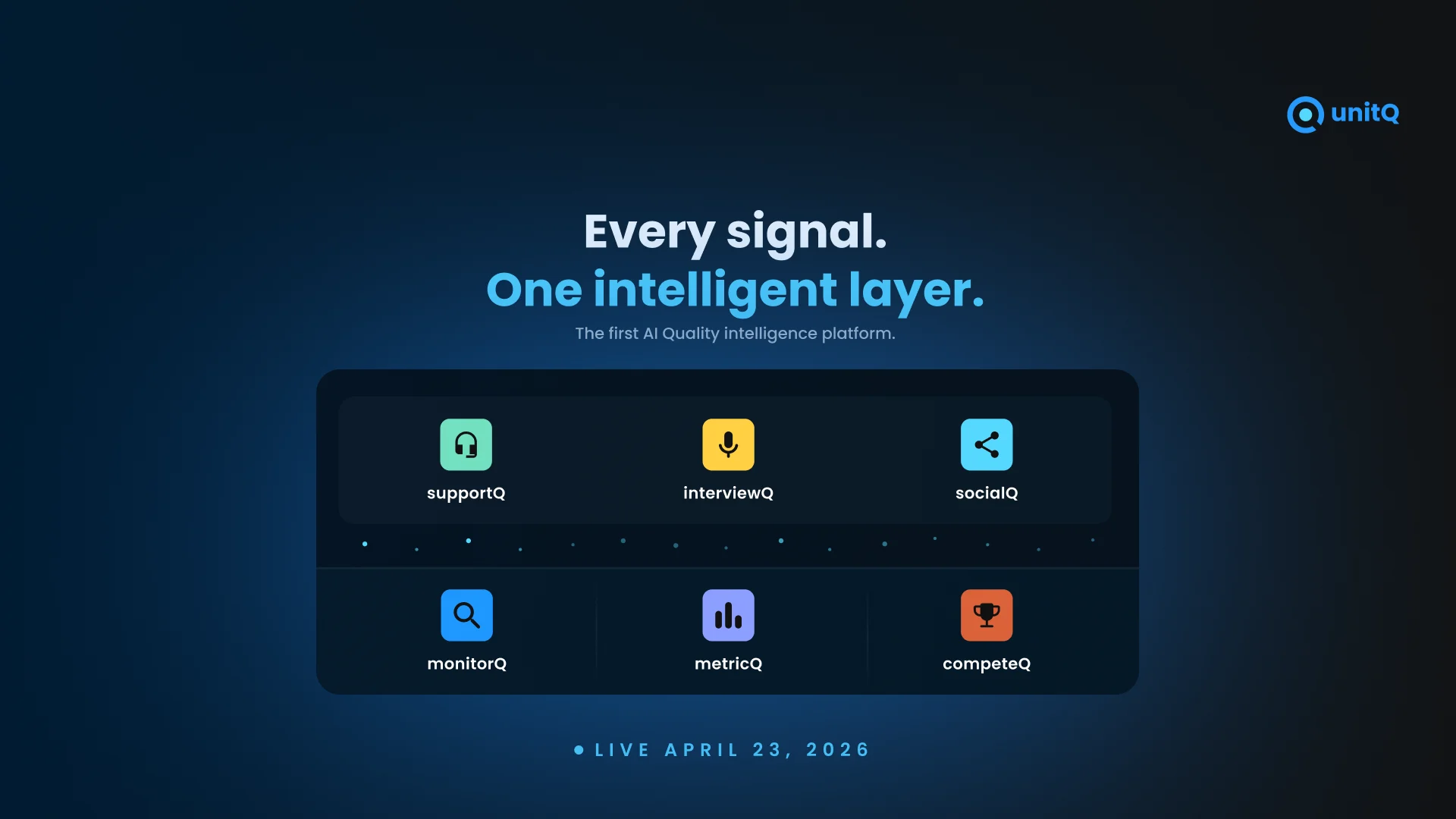
It starts with unitQ Monitor, the foundation everything else is built on. Monitor is the always-on feedback intelligence layer that unifies customer feedback from every source: support tickets, calls, app reviews, surveys, social media, and community forums. It surfaces issues and friction the moment they emerge, not the quarter they get reported. This is where customer truth enters the organization.
Detection alone isn’t enough. That’s where unitQ Impact changes everything. Most platforms stop at insight. Impact goes further: it connects every customer signal directly to the business metrics that drive your company, whether that’s total payments volume, member engagement, or subscriber retention. It quantifies the business impact of quality issues so teams can prioritize with confidence and make quality a board-level conversation, not a support metric. This is the piece that turns customer intelligence into a revenue conversation.
unitQ Compete extends that intelligence beyond your four walls. Your competitors’ customers are openly talking about what frustrates them and what they wish existed. Compete captures it in real time and benchmarks quality across the market, revealing where rivals are losing ground before anyone else has the data to see it.
Three additional products close the remaining gaps across customer-facing operations: unitQ Support evaluates every human and AI support interaction, not just the 3% that get sampled; unitQ Research delivers qualitative insight at scale in minutes, not months; and unitQ Social turns untagged social conversations into a proactive intelligence source, capturing brand signal before it becomes a crisis.
Picture this: it’s the day after a major launch. You’re not stuck in a war room. Not managing a PR crisis. Instead, you have a moment of total clarity.
Within hours, unitQ Monitor has surfaced a spike in friction among your highest-value customers, pinpointed to a specific flow. unitQ Impact has already quantified it: the revenue at stake, the retention risk, the precise segment most exposed. The team doesn’t waste time debating what to prioritize. They already know.
Then unitQ Support has seen every single interaction. It knows which agents followed protocol and which didn’t, which retention offers were made and which were left unsaid, and exactly where a bot handoff broke down and started costing you customers.
unitQ Compete has been watching your rivals. The same friction exists in their product. Their customers are saying so publicly. What could have been a crisis has become a window — a chance to move faster, communicate better, and take ground while a competitor stands still.
By the time your leadership team convenes, the problem is understood, the impact is quantified, the response is underway, and the opportunity is already in view. This isn’t incident management. This is what it looks like to operate at the speed of your customers.
The organizations that make this transition earliest will build advantages that compound with every passing quarter. Better products because they know what to build. Higher retention because they see problems before customers leave. Stronger market position because they move with intelligence their competitors can’t match.
Vani Kumar, Senior Director of Engineering at Pinterest, put it simply:
Pinterest is in the business of inspiring people. You cannot inspire someone who's having a less-than-ideal experience on the app. unitQ gives us the ability to have a true finger on the pulse of our millions of users — and now we're able to have intelligence and ask why across all of the users' experiences. That’s what it means to take quality seriously at Pinterest’s scale.
 Vani KumarSenior Director of Engineering at Pinterest
When you operate from customer truth, you stop managing opinions and start leading with clarity. Strategy becomes inevitable. And the distance between what your customers need and what your organization delivers collapses because everyone is working from the same reality.
None of this exists without the customers who believed in this vision early and pushed us to make it real: Adobe, Bumble, DraftKings, PayPal, Pinterest, Zendesk, and so many others who trusted us with something that matters deeply: their relationship with their customers.
The most customer-centric companies will define the next decade of business. The unitQ platform is how they get there.
See the unitQ platform → unitq.com/platform
Christian Wiklund is Co-founder & CEO of unitQ.
Join product and CX leaders getting the latest on customer intelligence, once a month.